Buying a House in 7 Years? How to Structure Your Equity Debt Allocation
Published by Anand Rathi Wealth Limited (ARWL) | NSE500-Listed Wealth Firm | Est. 2002
Association of Mutual Funds in India (AMFI) - Registered Mutual Fund Distributor | ARN: 111569
Published: October 1, 2026
Buying a residential property represents one of the largest financial commitments an individual or family plans for. When the planned purchase is seven years away, there is adequate time for capital to participate in equity compounding, while also establishing an objective-driven process to reduce risk as the transaction date nears.
The challenge is not simply deciding how much capital to invest each month. It is deciding how the asset allocation should systematically evolve across those seven years. An initial equity-led allocation supports capital growth, while a progressive transition toward fixed income protects the accumulated corpus when the funds are required.
A goal-based de-risking glide path is a pre-determined asset allocation schedule that progressively shifts capital from growth-oriented equities into capital-preserving debt instruments as a specific financial milestone approaches, insulating the corpus from market drawdowns.
What a 7-Year House Purchase Portfolio Looks Like
For any financial milestone with an investment horizon beyond three to five years, a higher equity weighting can be considered. For a seven-year property acquisition, a portfolio can begin with an 80:20 equity-to-debt structure.
The 80% equity component allows capital to compound alongside broader corporate earnings, while the 20% debt component provides stability and rebalancing liquidity from day one. However, an 80:20 split is merely the starting point. As the acquisition milestone draws closer, the asset mix must evolve through a defined glide path. To explore how foundational asset allocation protects long-term family wealth, review our analysis on
portfolio construction for HNIs and building a foundation for long-term wealth.
Diversification Within the Equity Bucket
Allocating 80% of a portfolio to equities does not mean concentrating capital in a single market segment or narrow theme. The equity portion should be diversified across multiple market capitalizations and complementary investment styles to avoid single-factor dependency.
Core Equity Categorization Framework
(Source: Anand Rathi Wealth Research)
Different equity categories behave distinctly across market cycles. Distributing capital across capitalization segments reduces reliance on any single area of the market.
For an objective tied to a specific calendar date, structural diversification is critical. The portfolio must navigate changing market phases without being derailed by style underperformance. To learn how to audit scheme overlaps and avoid duplicate stock exposure, read our guide on
mutual fund diversification beyond fund categories.
Why Sectoral and Thematic Funds Do Not Suit a Fixed Milestone
Sectoral and thematic funds experience sharp, unpredictable cyclical swings. Their performance depends on the fortunes of a narrow economic segment, which introduces significant entry and exit timing risk.
Concentrated thematic exposure creates elevated volatility. If a chosen theme enters a down-cycle during year five or six of a seven-year goal, the portfolio may lack the time required for a full recovery.
A fixed milestone requires predictability. A diversified equity approach keeps the portfolio focused on the financial goal itself, rather than forcing investors into tactical market timing.
Sizing and Structuring the Debt Component
Debt is not an element to introduce only when the property transaction is weeks away. It forms an integral part of the portfolio from the beginning, growing in importance as the milestone nears. The specific debt category chosen can be tailored to the investor's tax bracket and liquidity preferences.
Debt Instrument Selection by Tax Bracket
(Source: Anand Rathi Wealth Research)
Factors such as marginal tax rates, risk capacity, and the credit quality of underlying portfolio holdings must be evaluated when structuring the debt sleeve. The objective is to pair equity growth with debt stability to produce an uncomplicated investment experience. To see how separate liquidity reserves shield portfolios during market turbulence, review our blueprint on
liquidity planning in large portfolios and structuring short-term reserves.
The Dynamic Glide Path: Why Portfolios Cannot Stay Static
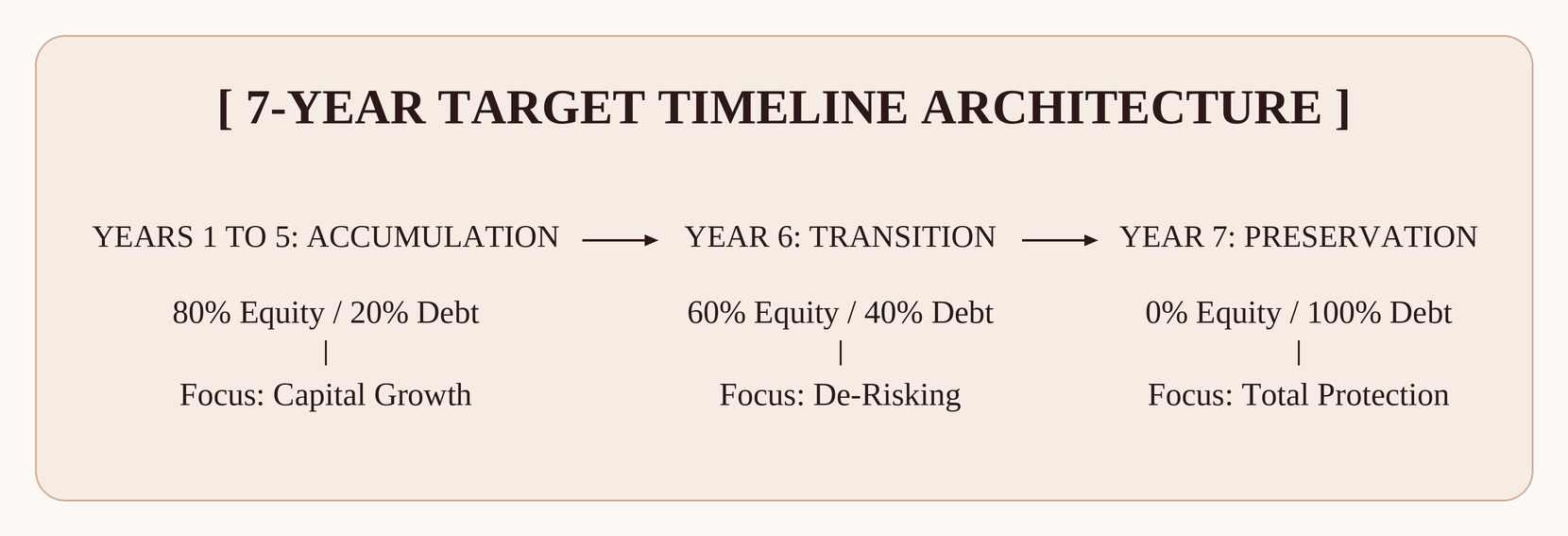
A common planning error is maintaining an 80:20 equity-to-debt ratio across all seven years. An asset mix that is appropriate when the goal is seven years away becomes unsuitable when only twelve months remain. As the capital requirement nears, progressive de-risking becomes essential.
7-Year Asset Allocation Glide Path
(Source: Anand Rathi Wealth Research)
Roughly two years before the planned purchase, the allocation shifts toward a 60:40 equity-to-debt mix. As the goal enters its final year, the portfolio transitions fully into debt and liquid instruments.
Why De-Risking Cannot Wait for the Final Months
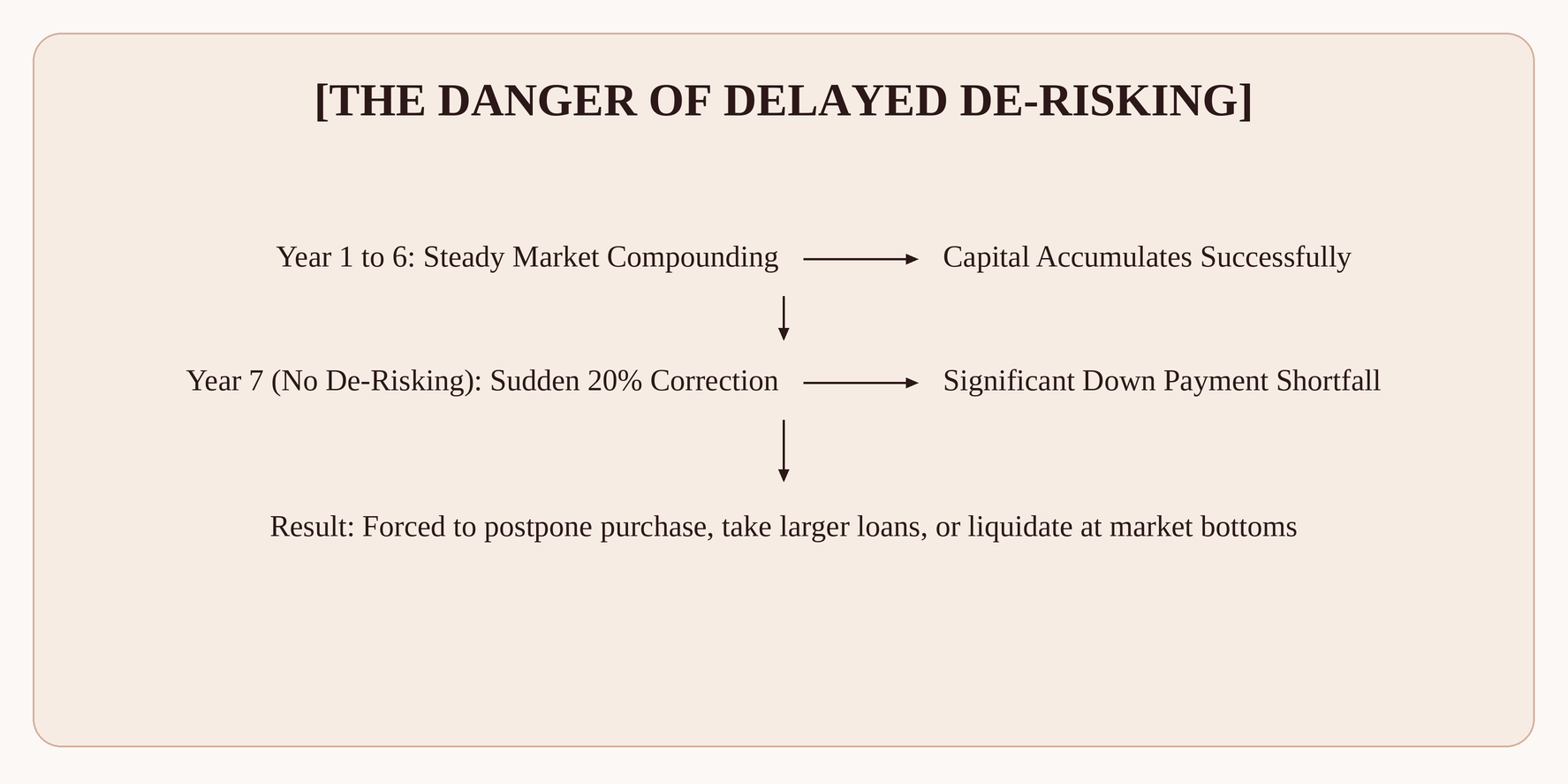
Consider what occurs when a portfolio remains 80% invested in equities up until the day of property registration. Even after six years of steady capital growth, a standard 15% to 20% market correction in year seven could wipe out a major portion of the accumulated down payment.
A scheduled, systematic transition toward fixed income removes dependency on short-term market movements. An investment horizon must dictate not only the initial asset mix, but also the scheduled timeline for de-risking.
Separating Distinct Financial Goals into Dedicated Portfolios
A house purchase may carry a seven-year timeline, whereas retirement could be two decades away and a secondary business outlay might be required within three years. Commingling multiple goals into a single aggregate portfolio obscures which assets belong to which timeline.
Maintaining separate portfolios for distinct milestones provides clear oversight:
- The property portfolio executes its 7-year de-risking glide path without interruption.
- Long-term retirement assets continue compounding undisturbed in diversified equities.
- Short-term lifestyle commitments remain insulated within liquid instruments.
Segregation ensures the asset mix remains aligned with the purpose of that capital throughout the entire journey.
A 4-Step Action Plan for a 7-Year Property Milestone
- Establish the Time Horizon: Anchor initial asset allocation in the seven-year timeline, starting with an 80:20 equity-to-debt structure.
- Diversify Across Capitalization and Styles: Distribute equity holdings across large, mid, and small cap schemes alongside varied investment styles, avoiding cyclical sector bets.
- Execute a Scheduled De-Risking Plan: Shift to a 60:40 allocation two years out, moving to 100% debt in the final year.
- Isolate the Objective: Keep property acquisition capital in a dedicated portfolio to prevent interference with other family wealth goals.
The process remains clear: Allocate, Diversify, De-Risk, and Protect. The portfolio changes because the target date is drawing near, not in response to short-term market noise.
Expert Perspective
"A seven-year house purchase objective does not require seven years of the same portfolio. The initial years can focus more on wealth creation. As the objective approaches, protecting what has already been accumulated becomes increasingly important. That makes the process uncomplicated: Allocate. Diversify. De-risk. Protect. The portfolio changes because the objective is getting closer, not because of short-term market noise."
Chirag Muni, Executive Director, Anand Rathi Wealth Limited
Chirag Muni
Executive Director, Anand Rathi Wealth Limited
About Anand Rathi Wealth
This article is published by
Anand Rathi Wealth Limited (ARWL), an NSE500-listed wealth firm established in 2002. ARWL works with 13,941 client families across India and abroad, managing assets of ₹1,06,300 crores across 18+ cities in India, alongside a dedicated international presence in Dubai and
the UK.ARWL operates as a CFO for personal wealth, bringing objective-driven portfolio construction, an uncomplicated process, and a long-term perspective that prioritises consistency of outcomes over short-term performance.
Our Approach to Investment Insights
At Anand Rathi Wealth, every insight is grounded in data, structured around a clear investment objective, and designed to be understood without jargon. The goal is not to impress, it is to inform. The insights in this article are designed to encourage evaluation of consistency over isolated returns, highlight the value of structured portfolio frameworks, and support informed decision-making.
This article has been reviewed for factual accuracy by Anand Rathi Wealth Limited's insight's function. This content is for informational and educational purposes only. It is designed to help readers make informed financial decisions. To understand how this content is created and reviewed, visit our
Content Standard Page.Disclaimer
This article is for informational and educational purposes only. The fund and scheme names used in this article are illustrative examples for explaining diversification and overlap. They should not be treated as investment action, product endorsement, or a promise of future performance.
FAQs
An initial asset allocation of 80% equity and 20% debt provides a balanced starting structure for a seven-year property milestone. The equity sleeve provides participation in corporate growth, while the debt sleeve offers baseline stability.