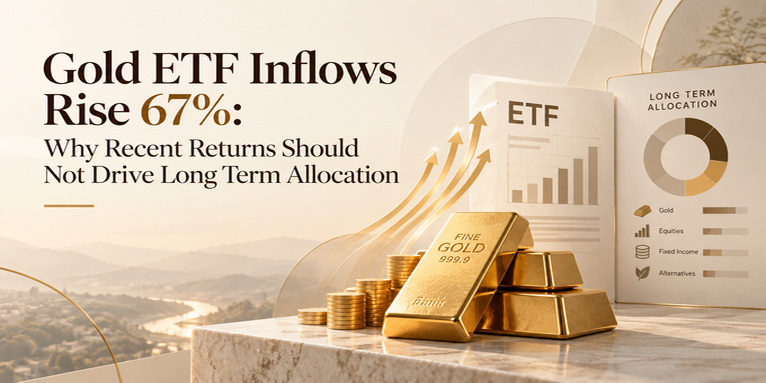
Gold ETF Inflows Rise 67%: Why Recent Returns Should Not Drive Long Term Allocation
Published by Anand Rathi Wealth Limited (ARWL) | NSE500-Listed Wealth Firm | Est. 2002
Association of Mutual Funds in India (AMFI) - Registered Mutual Fund Distributor | ARN: 111569
Published: October 1, 2026
Gold has returned to center stage across financial markets. Net inflows into Gold Exchange Traded Funds (ETFs) increased by approximately 67% in August 2026, reaching ₹2,596 crore compared to ₹1,558 crore in July. Simultaneously, domestic gold prices climbed by approximately 15% between July and August, supported by persistent geopolitical uncertainty, a softer US Dollar index, and declining treasury yields.
A sharp rise in prices combined with surging fund flows often makes an asset class appear compelling to the undisciplined eye. However, this momentum brings a recurring behavioral vulnerability into sharp focus: recency bias. Investors routinely give greater weight to assets that have performed well in the immediate past while moving away from assets that have experienced temporary periods of consolidation. Gold demonstrated this exact behavioral trap earlier in 2026.
For high-net-worth individuals (HNIs) and family offices, the strategic question is not simply why gold prices are climbing. The real inquiry is whether short-term price momentum should alter a portfolio or if gold even qualifies as a viable asset class for long-term wealth goals.
Recency bias in asset allocation is the psychological tendency to project immediate past performance into the indefinite future, prompting investors to overweight recently surging asset classes at cyclical peaks while disrupting their objective-driven portfolio structure.
Why Gold Lacks the Fundamentals of an Investment Asset
The core principle that separates growth assets from commodities is intrinsic growth. Equities derive their value from underlying businesses that sell goods, generate cash flows, innovate, and compound earnings over time. An investment in equity is a direct participation in corporate productivity and economic expansion.
Gold possesses no such attributes. It produces no cash flows, pays no dividends, and generates no earnings. Its price is driven by demand and supply, geopolitical uncertainty, central bank buying, currency movements, interest rate changes.
Because gold does not generate cash flows, it has no intrinsic value that an investor can model objectively. When an investor purchases gold, the outcome depends entirely on finding a buyer willing to pay a higher price later. A sharp rise in market price does not mean that the structural characteristics of gold have changed. It remains a non-productive commodity.
The Cycle of Recency Bias and Price Volatility
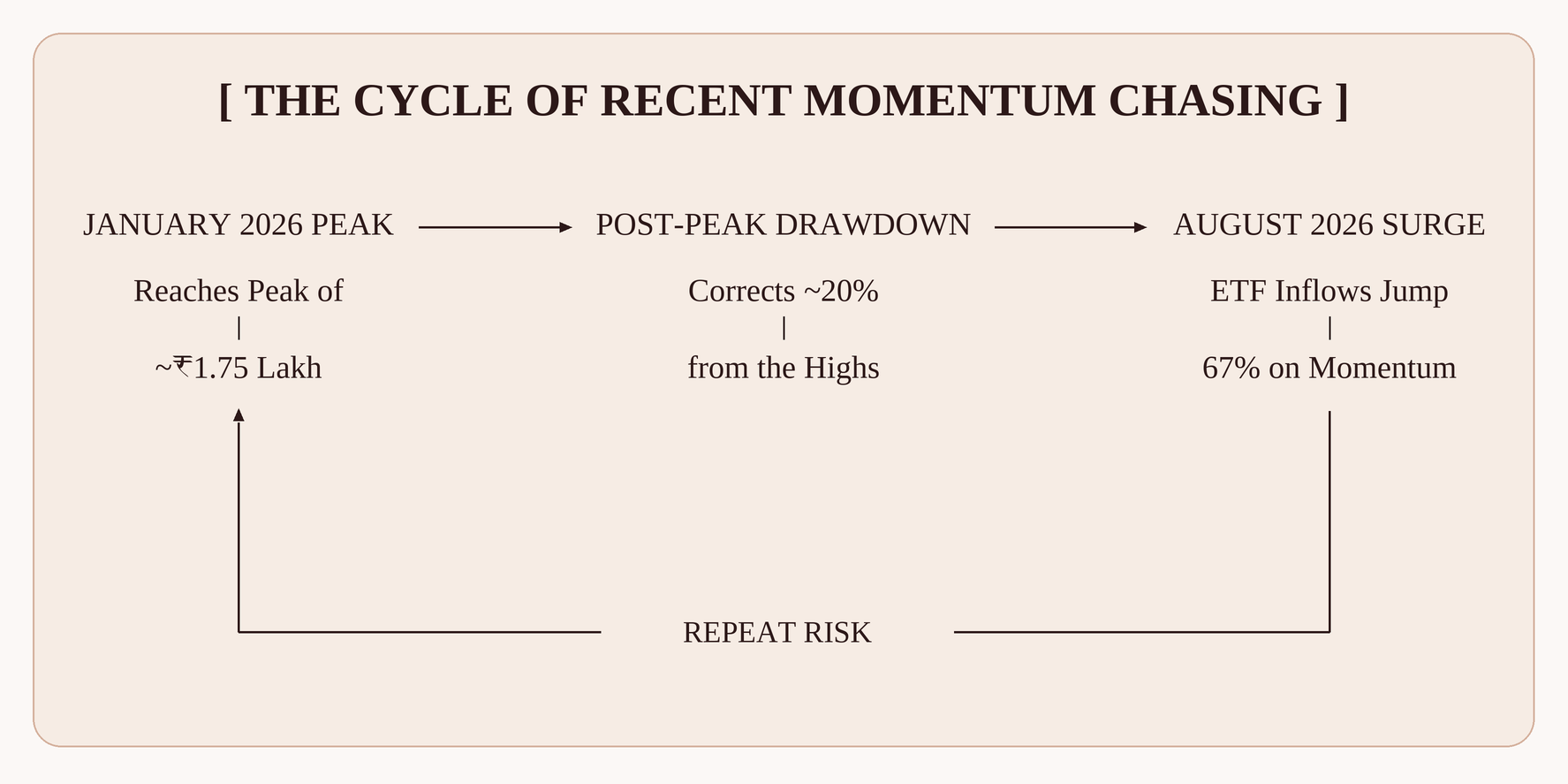
Past performance exerts a powerful emotional pull on investor behaviour. When an asset class rises rapidly over a matter of weeks, popular commentary assumes that the price trajectory will continue indefinitely. Yet the recent market experience of gold across 2026 illustrates why momentum chasing damages capital.
In January 2026, gold reached an all time high of around ₹1.75 lakh per 10 gm. Strong trailing returns attracted capital into the commodity at that peak. However, from its peak on 29 January to late July 2026, gold corrected by nearly 20%, falling to around ₹1.42 lakh per 10 gm. An investor who expanded allocations after observing the rally would therefore have experienced a significant drawdown soon after entering at elevated levels.
A structured capital allocation is built on a repeatable process rather than market movements across a few trading sessions. Recent performance explains where an asset has been; it does not determine where it belongs in a long-term portfolio. To understand how objective-driven frameworks prevent emotional mistakes, examine our core principles on
portfolio construction for HNIs and building a foundation for long-term wealth.
What Long-Term Data Proves About Gold Versus Equities
Evaluating long-term historical data provides clear perspective and removes emotional bias. Looking at market data since 1990 reveals a significant divergence in return probabilities between gold and diversified equities:
Historical Return Delivery Probability (1990 to Present)
(Source: Historical market trend analysis compiled by Anand Rathi Wealth Research. Past probability distributions serve strictly as an analytical baseline and do not represent a guarantee of future outcomes.)
These empirical probabilities explain why gold cannot fulfill the role of a wealth creation asset. In more than half of historical holding periods since 1990, gold failed to cross a basic 10% return threshold.
Risk-Adjusted Returns: Why Absolute Numbers Conceal the Truth
The structural inefficiency of gold becomes obvious when performance is evaluated through a risk-adjusted lens. Consider an empirical comparison of gold and equity returns from 2012 to the present:
Return and Risk-Adjusted Performance Comparison (Since 2012)
(Source: Comparative market metrics compiled by Anand Rathi Wealth Research. Sharpe ratio measures excess return generated relative to total volatility.)
Looking only at absolute numbers (11% for gold versus 12% for equity), an investor might assume that the two assets produced comparable outcomes. The Sharpe ratio reveals a completely different reality.
The Sharpe ratio for gold over this period was 0.38, compared to 1.25 for diversified equity. A Sharpe ratio below 1.00 indicates that the return generated did not adequately compensate the investor for the volatility experienced. Gold subjected investors to dramatic price swings and prolonged drawdowns simply to deliver an 11% average yield.
Why Anand Rathi Wealth Does Not Treat Gold as an Investment
Because gold lacks cash flow generation, carries a low Sharpe ratio, and displays unpredictable multi-year stagnation, Anand Rathi Wealth Limited does not treat gold as a core investment asset for wealth creation.
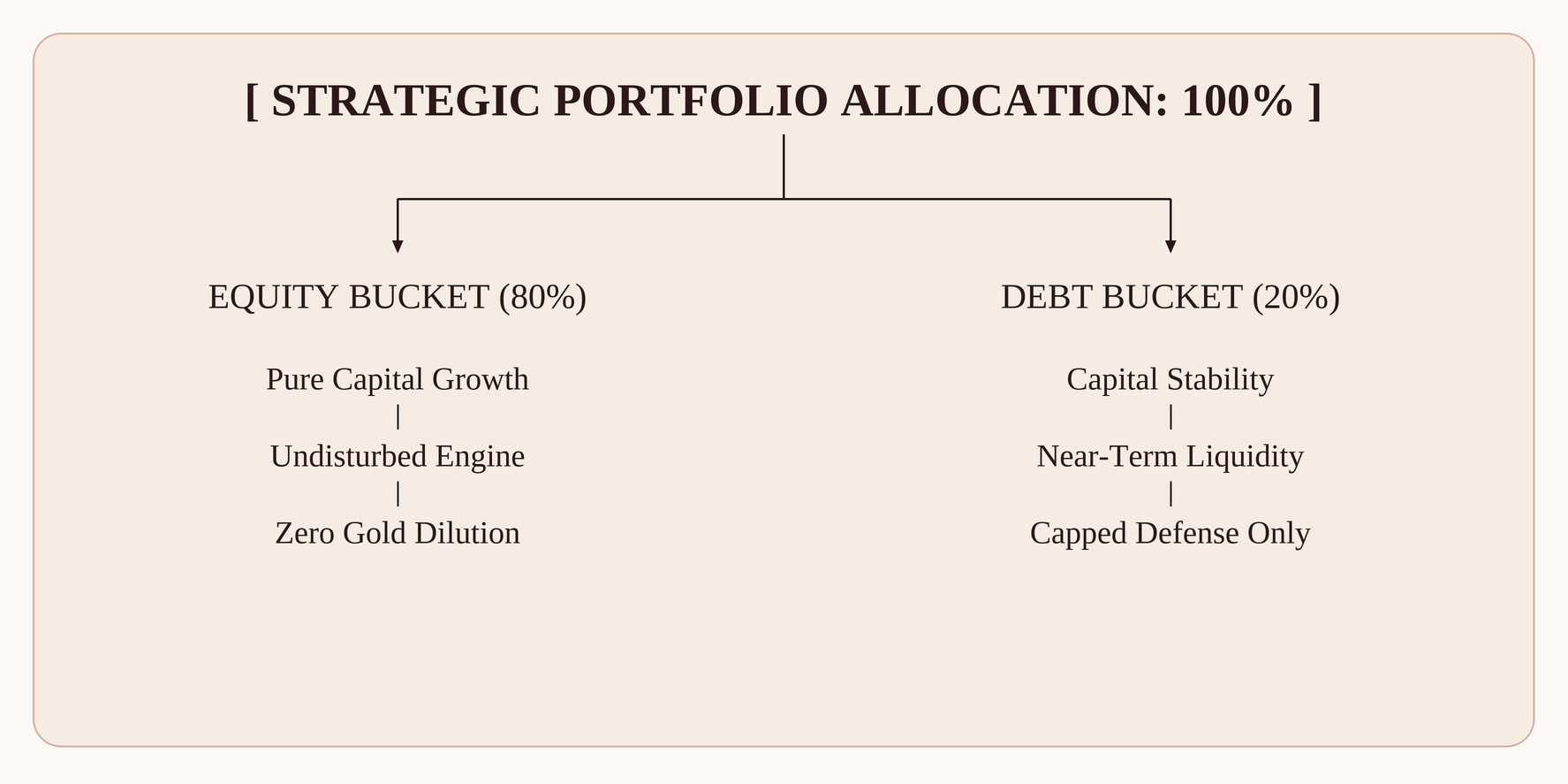
The firm's asset allocation process is anchored in an 80:20 equity-to-debt framework designed to achieve predictable wealth goals:
If an investor holds gold for cultural, traditional, or defensive reasons, it must never sit as an additional allocation or encroach upon the equity engine. It should be restricted strictly within the defensive debt allocation, capped at no more than 20% of that debt portion (representing no more than 4% of total wealth).
Can the Present Gold Rally Continue?
Gold price action is driven by multiple external catalysts:
- Fluctuations in geopolitical stability across global regions.
- Central bank physical reserve accumulation.
- Global interest rate expectations and sovereign debt yields.
- Fluctuations in the US Dollar index.
- Global commercial demand and mining supply constraints.
The August 2026 ETF surge represents a momentum-driven reaction to prevailing macroeconomic uncertainty rather than a fundamental shift in gold's structural characteristics.
Historical patterns show that when commodities deliver rapid gains in a compressed timeframe, they tend to mean revert over subsequent years. The 20% correction that followed gold's January 2026 all-time high serves as an active reminder that strong momentum phases are accompanied by volatility.
Three Principles for Long-Term Portfolio Discipline
Instead of reacting to monthly Gold ETF flows or short-term commodity price spikes, wealth owners should rely on three objective principles:
- Do Not Let Recent Performance Determine Asset Structure: A fast rally attracts headlines, but allocation choices must remain anchored in an objective-driven framework. The 20% drop from the January peak demonstrates how quickly sentiment shifts.
- Recognize Gold's Non-Productive Nature: Equities compound wealth through corporate earnings; gold generates no earnings. Gold should never be treated as a wealth creation vehicle or an alternative to equity.
- Preserve Portfolio Architecture Through Market Cycles: In an 80:20 equity and debt structure, defensive commodities should never expand beyond planned thresholds. Rebalancing systematically prevents temporary market movements from altering the intended risk profile of your estate.
The Uncomplicated Perspective: Clarity Over Noise
A 67% increase in Gold ETF inflows is a reflection of short-term sentiment. However, shifting sentiment does not alter the fundamental principles of wealth creation.
Sustainable wealth creation requires filtering out market noise. Instead of asking which asset class moved fastest over the past month, investors must evaluate whether their portfolio structure supports their long-term wealth goals. Long-term compounding belongs in productive, diversified equities, supported by stable fixed income for liquidity. To examine how a dedicated stability reserve protects compounding assets during market stress, read our guide on
liquidity planning in large portfolios and structuring short-term reserves.
Expert Perspective
"Investors should remember that gold's price movements have no fundamental backing and are primarily driven by macroeconomic factors, currency shifts, and demand-supply dynamics. Hence, renewed interest can be largely attributed to its recent performance. Investors should avoid recency bias, refrain from relying on gold as a core asset class, and stick to an objective-driven allocation of 80:20 in equity to debt, keeping any gold exposure strictly within the defensive debt portion."
Jasmeet Singh, Executive Director, Anand Rathi Wealth Limited
Jasmeet Singh
Executive Director, Anand Rathi Wealth Limited
About Anand Rathi Wealth
This article is published by
Anand Rathi Wealth Limited (ARWL), an NSE500-listed wealth firm established in 2002. ARWL works with 13,941 client families across India and abroad, managing assets of ₹1,06,300 crores across 18+ cities in India, alongside a dedicated international presence in Dubai and
the UK.ARWL operates as a CFO for personal wealth, bringing objective-driven portfolio construction, an uncomplicated process, and a long-term perspective that prioritises consistency of outcomes over short-term performance.
Our Approach to Investment Insights
At Anand Rathi Wealth, every insight is grounded in data, structured around a clear investment objective, and designed to be understood without jargon. The goal is not to impress, it is to inform. The insights in this article are designed to encourage evaluation of consistency over isolated returns, highlight the value of structured portfolio frameworks, and support informed decision-making.
This article has been reviewed for factual accuracy by Anand Rathi Wealth Limited's insight's function. This content is for informational and educational purposes only. It is designed to help readers make informed financial decisions. To understand how this content is created and reviewed, visit our
Content Standard Page.Disclaimer
This article is for informational and educational purposes only. The fund and scheme names used in this article are illustrative examples for explaining diversification and overlap. They should not be treated as investment action, product endorsement, or a promise of future performance.
FAQs
Gold ETF inflows reached ₹2,596 crore in August 2026 due to strong price momentum driven by persistent geopolitical uncertainty, a weakening US Dollar, and declining sovereign bond yields. These factors contributed to a 15% domestic price increase between July and August, attracting momentum-driven capital.